Vocal range and voice types: how to find yours
Updated · 7 min read
Your vocal range is the stretch of notes you can sing, from your lowest to your highest, and it's the quickest way to pick songs that suit you. This guide explains how a range is written and measured, what the six voice types are and how far apart they sit, how to read a result, and what range alone can't tell you. The numbers come from the same table our free vocal range test uses, so you can check every one of them against your own voice.
What a vocal range is (and what it isn't)
A range is written as two notes: the lowest and the highest you can sing, like G2–E4. Each note is a letter and a number. The letter is the note's name, and the number says which octave it's in: middle C on a piano is C4, and the number goes up by one at every C. So B3 is the white key just below middle C, and C5 is the C an octave above it.
The distance between two notes is counted in semitones, one step from any key on a piano to the very next one, black or white. Twelve semitones make an octave, the jump to the same note name higher up, where the pitch has doubled. A range of G2–E4 is 21 semitones, which is 1.8 octaves.
What it isn't: a grade, or a fixed fact about you. A range moves with the day, with how warmed up and rested you are, and with what counts as a note. Most singers can croak a few notes below their useful bottom and squeak a few above their useful top. Those don't help you choose songs, so it's worth measuring the notes you can hold steadily and comfortably, on a plain vowel, without pushing. That is what our test asks for, and it's the range the rest of this guide means.
The six voice types and their typical notes
Choirs and voice teachers sort voices into six main types. Starting from the bottom: bass, baritone and tenor, usually men's voices, and alto, mezzo-soprano and soprano, usually women's voices and children's. Each type has a typical range, and the table below gives the ranges our test compares you with.
Two things stand out once the numbers sit side by side. First, every typical range is the same size, two octaves; the types differ in where those two octaves sit, not in how wide they are. Second, the types are close together: each one's lowest note sits a minor third to a perfect fourth higher than the one below, just 3, 4 or 5 semitones. A tenor's range (C3–C5) and an alto's (F3–F5) share F3–C5, nearly all of both. That's why your range often fits two types, and why range alone can't settle which one you are.
The men's and women's types line up an octave apart. A tenor's C3–C5 is a soprano's C4–C6 one octave down, note for note, and a baritone's range is a mezzo-soprano's an octave lower. When a man sings a melody written for a woman's voice, he usually sings the same notes an octave down without thinking about it; the key doesn't need to change for that.
| Voice type | Typical range | In hertz | Span | Lowest note, up from the type below |
|---|---|---|---|---|
| Bass | E2–E4 | 82 to 330 Hz | 24 semitones, 2 octaves | The lowest type |
| Baritone | A2–A4 | 110 to 440 Hz | 24 semitones, 2 octaves | 5 semitones |
| Tenor | C3–C5 | 131 to 523 Hz | 24 semitones, 2 octaves | 3 semitones |
| Alto | F3–F5 | 175 to 698 Hz | 24 semitones, 2 octaves | 5 semitones |
| Mezzo-soprano | A3–A5 | 220 to 880 Hz | 24 semitones, 2 octaves | 4 semitones |
| Soprano | C4–C6 | 262 to 1047 Hz | 24 semitones, 2 octaves | 3 semitones |
How to measure yours with a mic
Take the free vocal range test
- 1Pick a quiet spot with nothing playing. The mic built into your phone or laptop does the job; there's no need for a studio one.
- 2Warm up for a minute or two with gentle hums or slides, the way you would before singing, so the test hears your voice as it is when you sing.
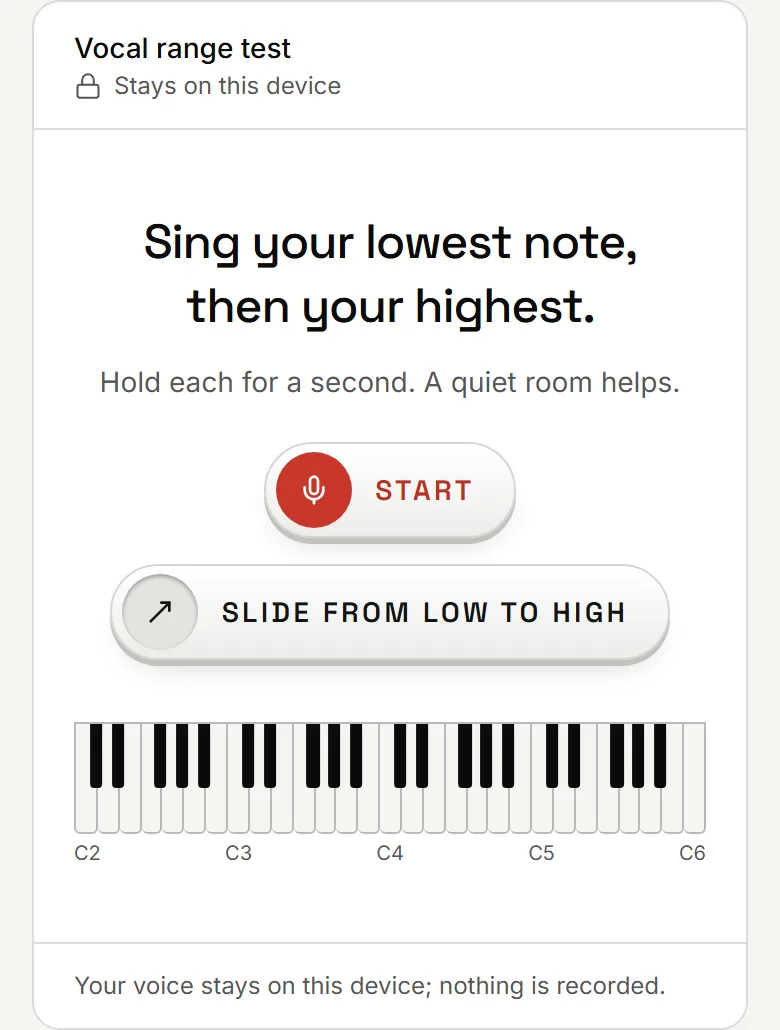
- 3Open extractune.com/vocal-range-test and press Start; say yes when the browser asks to use the mic.
- 4Go to the bottom first: an easy, open "ah" on the lowest note that still feels like singing, held still until the ring around it completes.
- 5Then the top, the same way: the highest note you could use in a song, not a squeak. If held notes feel awkward, use the slide button and glide up from the bottom instead.
- 6Note down both ends, the size in octaves and the type it suggests. A note you don't trust? Run it again; it takes seconds.
Getting a reading you can trust
A range is only as good as the two notes you give it, so a few habits make the result worth keeping. Test at the time of day you usually sing, after the same warm-up, and run it twice: keep the notes both runs agree on, not the best one you hit once.
The test hears pitch, not register. A top note in falsetto or head voice counts the same as one in chest voice, so decide which you're measuring. It can help to write down two tops: your highest chest note, and your highest note in any voice, which tells you whether a chorus that jumps up is within reach.
At the bottom, a gravelly or creaky note that won't hold still isn't kept, because the test waits for a steady pitch. That's a useful filter: a note you can't hold steady isn't one you'll use in a song either.
How the vocal range test reads your voice, and how accurate it is
Reading a result: a worked example
Say the test reads G2–E4. That's 21 semitones, 1.8 octaves, and the type it names is bass. Here's how it decides. For each type it adds up two distances: from your lowest note to the type's lowest, and from your highest to the type's highest. The type with the smallest total is named. Here the top note matches the bass's E4 exactly and the bottom is three semitones above the bass's lowest note, while a baritone's would be further off in total: two semitones at the bottom, but five at the top.
Now say the test reads A3–F5: 20 semitones, 1.7 octaves. This range sits between two types, and the test names both, alto and mezzo-soprano, because they're equally close. It names a second type whenever it's nearly as close as the first, since the ranges overlap so much. Two names isn't a vague answer: it says where your range sits, and the rest of the decision comes from things a microphone can't measure.
Don't read too much into the octave count on its own. A range a little under two octaves doesn't rule many songs out; what decides whether a song suits you is where its melody sits against your range, and that's the part you can change: the key.
Range is not the whole picture
Voice teachers place a voice by more than its two end notes. Tessitura is where your voice is most comfortable, the stretch where you could sing for an hour; two singers with the same range can have very different tessituras. Tone matters too: how heavy, dark, bright or light the voice sounds. And so does the passaggio, the places where your voice shifts between registers, such as from chest voice into head voice; where those shifts fall is one of the clearest signs of a voice type.
So treat the test's answer as where your range points, not a label. If you want to know your voice type for a choir audition or for lessons, a voice teacher listens for all of this in a few minutes.
Can your range grow? Voice teachers say it often widens with training, mostly at the top, as you learn to move between registers smoothly. Give that to a teacher rather than to pushing harder on your own: if a note hurts or strains, stop. A range measured on a good day, warmed up and relaxed, is the honest one.
Pick songs that fit: find the key, move it
Once you know your range, compare it with the song's melody: its lowest and highest notes. Sing along with the lowest line and the highest one, or find them on a piano app. If the top note is two semitones above your highest comfortable note, the song needs to come down two semitones, and every other note comes down with it.
To find where a song sits, start from its key: our finder reads it from the recording, and the key guide shows how to check it by ear. Then the pitch changer shifts the whole track, as far as 12 semitones lower or higher, at its original tempo. Singing over it alone? Take the voice out first; the backing track guide covers that.
Questions
What is a normal vocal range?
There isn't one normal range. The typical range for each voice type is two octaves, and many untrained singers comfortably cover a bit less. What matters for choosing songs is where your range sits, not only how wide it is.
What's the difference between range and tessitura?
Range is every note you can sing, lowest to highest. Tessitura is the part of it where your voice is most comfortable and sounds its best for long stretches. A song that stays in your tessitura feels easy; one that sits at the edges of your range tires you out even if you can reach every note.
Can my range change with practice?
Voice teachers say it often widens with training, as you learn to move between registers. It also changes day to day with warm-up, rest and health. A teacher is the right person to guide that; don't push through strain.
Does falsetto count?
Yes. The test hears pitch, not register, so a steady falsetto note counts like any other. If you want your chest-voice range only, stop at your highest chest note.
Why is my range different from last time?
Ranges move with warm-up, tiredness, health and the time of day, and with how hard you pushed. Compare results taken the same way, at the same time of day, and trust the notes that keep coming back.